News
Tegbe commissions 2.2MW of solar infrastructure, 100 electric taxis

Tegbe commissions 2.2MW of solar infrastructure, 100 electric taxis

L-R: Zamfara State Governor, Dauda Lawal, one of the develeopers, Minister of Power, Joseph Tegbe and Managing Director of the Rural Electrification Agency (REA), Abba Aliyu at the groundbreaking of 37 mini-grid projects across seven Local Government Areas of Zamfara state on Wednesday.
AJAGBE ADEYEMI TESLIM
SPONSORED BY: H&H
Zamfara State has taken significant steps towards developing its electricity market, expanding renewable energy infrastructure and strengthening energy security, as the Federal Government, through the Rural Electrification Agency (REA), marked the groundbreaking of 37 mini-grid projects across seven Local Government Areas of the state.
The event, attended by the Honourable Minister of Power, Chief Joseph Olasunkanmi Tegbe; the Executive Governor of Zamfara State, His Excellency Dr. Dauda Lawal; and the Managing Director/Chief Executive Officer of the REA, Dr. Abba Aliyu, featured several interventions spanning electricity market development, renewable energy deployment, healthcare electrification and clean transportation.
In a major policy development, Governor Dauda Lawal formally unveiled the Zamfara State Electricity Policy, establishing a strategic foundation for the development of a state electricity market under the opportunities created by the Electricity Act 2023.
The Zamfara State Government and the Rural Electrification Agency also signed a landmark collaboration agreement for the solarisation of public institutions across the state, providing a framework for expanding reliable renewable electricity supply to critical government facilities.
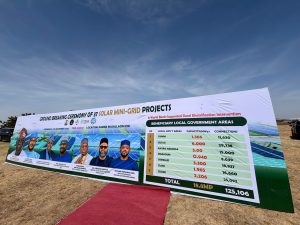
The planned electrification programme comprises 2 interconnected mini-grids and 35 isolated mini-grids, representing approximately 18.8 megawatts-peak (MWp) of solar generation capacity and 125,106 planned electricity connections** across Gummi, Gusau, Kaura Namoda, Maradun, Shinkafi, Tsafe and Zurmi Local Government Areas.
The unveiling of the Zamfara State Electricity Policy represents an important step towards establishing a structured, commercially viable and investment-friendly electricity market.
With the Electricity Act 2023 providing opportunities for states to assume greater responsibility for electricity market development, Zamfara is positioning itself to attract private investment, promote decentralised energy infrastructure and align electricity planning with its economic development priorities.
The policy is expected to provide strategic direction for institutional coordination, market development, private-sector participation and the long-term sustainability of electricity services.
Complementing this policy direction, the collaboration agreement between the state government and REA establishes a pathway for the solarisation of public institutions, including healthcare facilities, educational institutions and other essential government infrastructure.
The partnership is intended to improve electricity reliability, reduce dependence on expensive fossil-fuel-based generation and demonstrate how renewable energy can strengthen public service delivery while improving long-term operational efficiency.
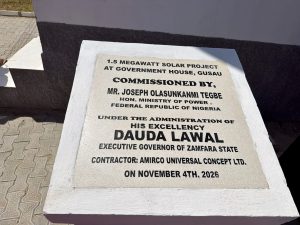
As part of the event, the Honourable Minister of Power commissioned two solar mini-grid projects developed by the Zamfara State Government.
The projects include a 1MW solar mini-grid at Yariman Bakura Specialist Hospital, designed to support reliable electricity for healthcare delivery, and a 1.2MW solar mini-grid serving the Zamfara State Government House, strengthening electricity supply for government operations.
Together, the projects represent 2.2MW of commissioned solar generation capacity with over 3MW battery storage.
The Minister also unveiled 100 ZamTaxi electric vehicles, marking an expansion of clean transportation initiatives in the state.
In a complementary healthcare intervention, 10 electric tricycles dedicated to maternal health services were unveiled to support improved access to healthcare transportation, particularly for pregnant women and mothers.
Additionally, 2 Compressed Natural Gas (CNG) buses donated by the Presidential Initiative on Compressed Natural Gas (Pi-CNG) were unveiled, reinforcing the Federal Government’s efforts to encourage alternative transportation fuels.
These initiatives illustrate the growing intersection between electricity infrastructure, healthcare, transportation and economic development.
Speaking at the event, Governor Dauda Lawal described the unveiling of the state’s electricity policy and the partnership with REA as important steps in the government’s broader economic development strategy.
“Today, we are taking deliberate steps to redefine Zamfara’s electricity future. The unveiling of our State Electricity Policy is a statement of our intention to build a structured, investment-friendly and sustainable electricity market that responds to the needs of our people and the ambitions of our economy.”
“We recognise that reliable electricity is indispensable to agricultural transformation, industrial development, healthcare delivery, education and job creation.”
“Our collaboration with the Rural Electrification Agency on the solarisation of public institutions reflects our determination to translate policy into practical infrastructure that improves the delivery of essential services.”
“We are equally committed to ensuring that renewable energy becomes an important driver of enterprise development, economic opportunity and prosperity across Zamfara State.”
“Our objective is to create an electricity ecosystem in which government provides the enabling environment, private investors bring capital and innovation, and our communities benefit from reliable and affordable electricity.”
Also speaking at the event, the Honourable Minister of Power, Chief Joseph Olasunkanmi Tegbe, described the event as a demonstration of the Federal Government’s commitment to expanding electricity access and supporting state participation in electricity market development.
“Under the Renewed Hope Agenda of President Bola Ahmed Tinubu, GCFR, the Federal Government is pursuing an electricity transformation strategy that recognises the critical role of decentralised infrastructure, state-level market development and private-sector investment.”
“The unveiling of the Zamfara State Electricity Policy, the groundbreaking of new mini-grid infrastructure and the commissioning of renewable energy projects demonstrate how policy reforms can be translated into practical development outcomes.”
“Electricity must do more than illuminate homes. It must power hospitals, strengthen educational institutions, support agricultural productivity, enable businesses and improve the quality of public services.”
“The Federal Government will continue to support states that are taking practical steps to develop their electricity markets and create the conditions necessary for sustainable private investment.”
“What we are witnessing in Zamfara reflects the integrated approach required to address Nigeria’s electricity challenges while creating new opportunities across the economy,” he said.
In his remarks, the Managing Director/Chief Executive Officer of the Rural Electrification Agency, Dr. Abba Aliyu, described the Zamfara intervention as an opportunity to demonstrate a new model of electricity development in Nigeria, combining infrastructure investment, state-level policy reform, institutional electrification and private-sector participation.
“Today, Zamfara is doing something fundamentally important. We are moving beyond the traditional approach of treating electricity access as a series of isolated infrastructure projects towards building an integrated electricity economy supported by policy, investment, institutions and sustainable market structures.”
“Through the REA, we are advancing 37 mini-grid projects comprising two interconnected and 35 isolated systems, with approximately 18.8MWp of solar generation capacity and 125,106 planned electricity connections across seven Local Government Areas.”
“At an illustrative average of five people per household-equivalent connection, this represents a potential reach of more than 625,000 people, subject to the actual mix of household, commercial and institutional connections.”
“But these figures tell only part of the story. The real economic significance of 125,106 electricity connections is not simply the number of households that may receive power. It is the number of businesses that can become productive, the agricultural value chains that can be strengthened, the jobs that can be created, the public institutions that can function more efficiently and the private investments that reliable electricity can unlock.”
“That is why the unveiling of the Zamfara State Electricity Policy is particularly significant. Infrastructure without an enabling market framework risks becoming a collection of disconnected assets. However, when electricity infrastructure is supported by clear policies, effective institutions, commercially viable tariffs, credible regulation and predictable investment conditions, it becomes the foundation of a sustainable electricity economy.”
“The collaboration agreement we have signed with the Zamfara State Government for the solarisation of public institutions is equally strategic. Across Nigeria, public institutions continue to face the financial and operational consequences of unreliable electricity. Hospitals, schools and government facilities often depend on expensive alternative generation, diverting scarce resources away from essential services.”
“Through this partnership, our objective is to demonstrate how decentralised renewable energy can improve service delivery, reduce long-term operating costs and establish commercially sustainable models for powering critical public infrastructure.”
“More importantly, these institutions can provide anchor demand for electricity investments, helping improve project bankability and creating opportunities to extend reliable power to surrounding communities and businesses.”
“At the REA, we are increasingly focused on three fundamental outcomes: how much electricity infrastructure we can deliver, how much private capital that infrastructure can mobilise, and how much economic value each investment can create.”
“Under the $750 million World Bank-supported Distributed Access through Renewable Energy Scale-up (DARES) programme, our national ambition is to expand electricity access to approximately 17.5 million Nigerians, while supporting the development of around 1,350 mini-grids and scaling distributed renewable energy solutions.”
“Zamfara’s intervention must therefore be understood within this broader national transformation. The future of electricity access in Nigeria will not be determined by how much government can spend alone. It will be determined by how effectively government can use policy, public investment and institutional coordination to unlock private capital, establish viable electricity markets and create economic opportunities that endure long after projects have been commissioned.”
“Our ultimate ambition is not simply to connect Zamfara to electricity. It is to connect Zamfara’s people, businesses and institutions to a new economy of productivity, investment and opportunity. That is the real measure of success, and that is the transformation we are committed to delivering.”
The REA’s planned electrification portfolio covers seven Local Government Areas, with the following indicative generation capacities and connections:
Local Government Area
Solar capacity
Planned connections
Gummi
1.366 MWp
11,630
Gusau
6.000 MWp
29,738
Kaura Namoda
3.000 MWp
15,000
Maradun
0.940 MWp
8,049
Shinkafi
3.300 MWp
18,937
Tsafe
1.965 MWp
16,660
Zurmi
2.206 MWp
25,092
Total
18.777 MWp
125,106
The planned investments are expected to strengthen electricity access for households, commercial enterprises, agricultural activities and public institutions, while supporting local economic development.
The Zamfara intervention highlights the opportunities available to Nigerian states as the electricity sector undergoes structural transformation.
By combining an electricity policy framework, a pipeline of decentralised generation projects, institutional solarisation and clean mobility initiatives, Zamfara is pursuing an integrated approach to energy development.
The REA will continue to support the state through technical collaboration, project development and private-sector engagement, with particular emphasis on the commercial sustainability of electricity infrastructure and its contribution to economic productivity.
The collaboration agreement on public institution solarisation also provides an opportunity to explore scalable financing and implementation models that could be replicated across other states.
As Nigeria advances its electricity access and energy transition objectives, the Zamfara initiative demonstrates how coordinated federal and state action can help translate sector reforms into practical infrastructure and measurable economic benefits.

